

Infrared Beacons
Infrared beacons are installed on ordinary trunk roads (in approximately 33,000 locations), providing traffic information primarily for ordinary roads 30 km ahead in the vehicle’s direction of travel and 1 km behind.
The reception range of beacons is approximately 3.5 meters in front of the beacon. They mainly provide information about conditions in the direction of travel.
 Main Information Provided
- Congestion Information
- Travel Time Information
- Traffic Restriction Information
- Traffic Hindrance Information
- Parking Lot Information
TSPS (Traffic Signal Prediction System)
TSPS (Traffic Signal Prediction System) is a driver assistance system that facilitates unconstrained driving through intersections with traffic signals. Based on data about traffic signals obtained from infrared beacons combined with vehicular location, speed, and similar data, an onboard unit can provide appropriate speed recommendations and other information that is tailored to the traffic and road conditions.
This driver assistance system helps to reduce unnecessary acceleration and sudden braking to enable leisurely, safe, hindrance-free driving in addition to promoting fuel efficiency and CO2 emission reduction.

-
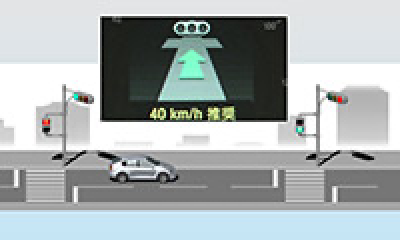
Signal Passing Support
The recommended speed is displayed by the car navigation unit. This helps driving through intersections go more smoothly.
-
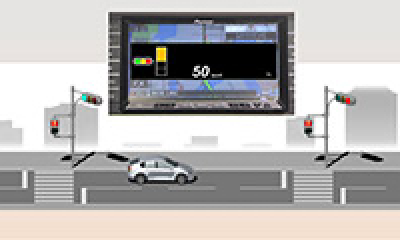
Signal Stopping Support
Based on the status of the road ahead, the car navigation system may advise you to reduce speed. Taking your foot off the accelerator early allows for smoother deceleration.
-
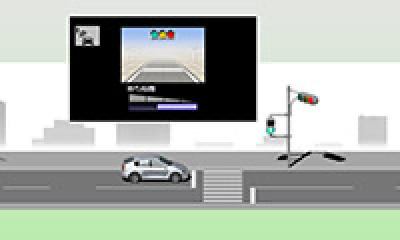
Signal Change Starting Support
The remaining time until the traffic signal switches from red to green is displayed by the car navigation system. This helps you get off to a smoother start at intersections.


In order to utilize the TSPS (Traffic Signal Prediction System) driver assistance system, a TSPS-compatible onboard unit is required.
DSSS (Driving Safety Support System)

- DSSS (Driving Safety Support System) will be terminated on March 31, 2027.